


 Sergio Caredda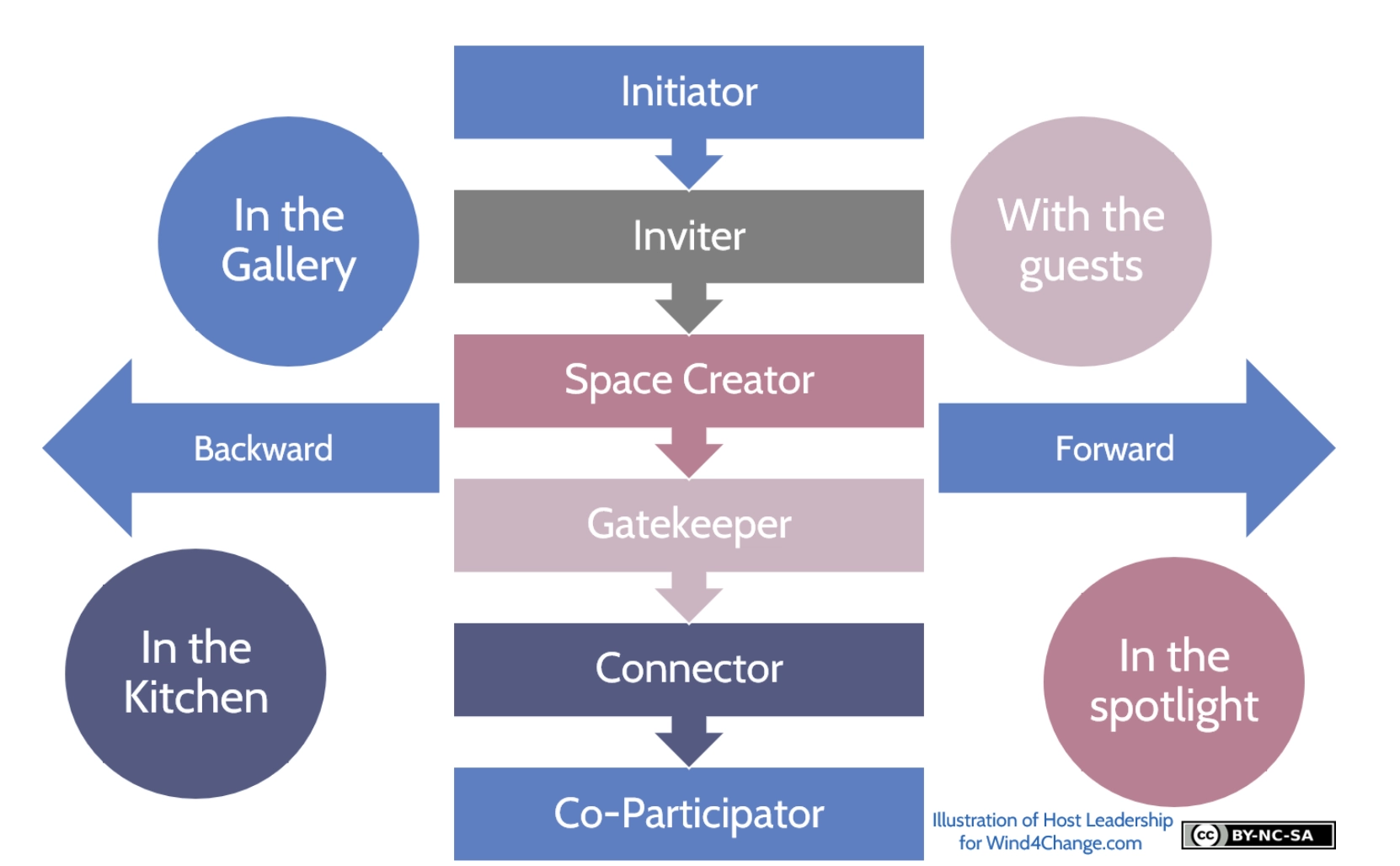
Mark McKergow & Helen Bailey
McKergow, M., & Bailey, H. (2014). Host: Six New Roles of Engagement for Teams, Organisations, Communities and Movements. Solutions Books.

Description
Host Leadership, developed by Mark McKergow and Helen Bailey (2014), offers a post-heroic leadership model that reframes the leader's role using the metaphor of a host — someone who creates the conditions for guests to thrive, rather than a hero who leads from the front or a servant who follows from behind.
The model emerged from years of observing leaders who seemed to operate like great hosts, and hosts (from TED's Chris Anderson to mountaineer Chris Bonington) who displayed remarkable leadership qualities. It positions hosting as a fundamentally different relationship with others: invitational, relational, and context-creating rather than directive or deferential.
The model has two main components:
Six Roles of the Host Leader
- Initiator — Sees what needs doing and starts things moving, responding to a call to action
- Inviter — Thinks invatationally, offering participation as a gift rather than demanding it
- Space Creator — Designs and shapes the physical and psychological environment for engagement
- Gatekeeper — Manages who is in, who is out, and what values and norms govern the gathering
- Connector — Introduces people to each other, facilitates relationships and knowledge flow
- Co-Participator — Joins in the work alongside others, modelling engagement and belonging
Four Positions of the Host Leader
- In the Spotlight — Visible, public-facing, presenting direction or vision
- With the Guests — Present and engaged 1:1 or in small groups; listening and connecting
- In the Gallery — Observing from a distance; watching patterns, reflecting
- In the Kitchen — Behind the scenes; preparing conditions, doing invisible work
The power of the model lies in the intentional movement between these positions and roles — recognising that leadership is not a single stance but a contextual dance. Leaders often default to the spotlight and neglect the kitchen; Host Leadership makes the full range explicit.
→ Martin Fowler's Bliki note on Host Leadership
Notes
- Explicitly positions itself as beyond both Servant Leadership (Greenleaf, 1977) and the "heroic leader" archetype — hosts lead from the centre, not from the front or the back.
- Strong resonance with Agile and self-managing team contexts, where psychological safety and invitation matter more than instruction.
- The "kitchen" metaphor is particularly useful for leaders who feel they must always be visible — it legitimises invisible preparation work as leadership.
- Connects well with Collective Leadership frameworks and systems convening approaches.
- McKergow's work is rooted in Solutions Focus methodology and Adlerian psychology.
Other Sources
Books:
- McKergow, M., & Bailey, H. (2014). Host: Six New Roles of Engagement for Teams, Organisations, Communities and Movements. Solutions Books.
- McKergow, M., & Pugliese, P. (2019). The Host Leadership Field Book. Solutions Books
