


 Sergio Caredda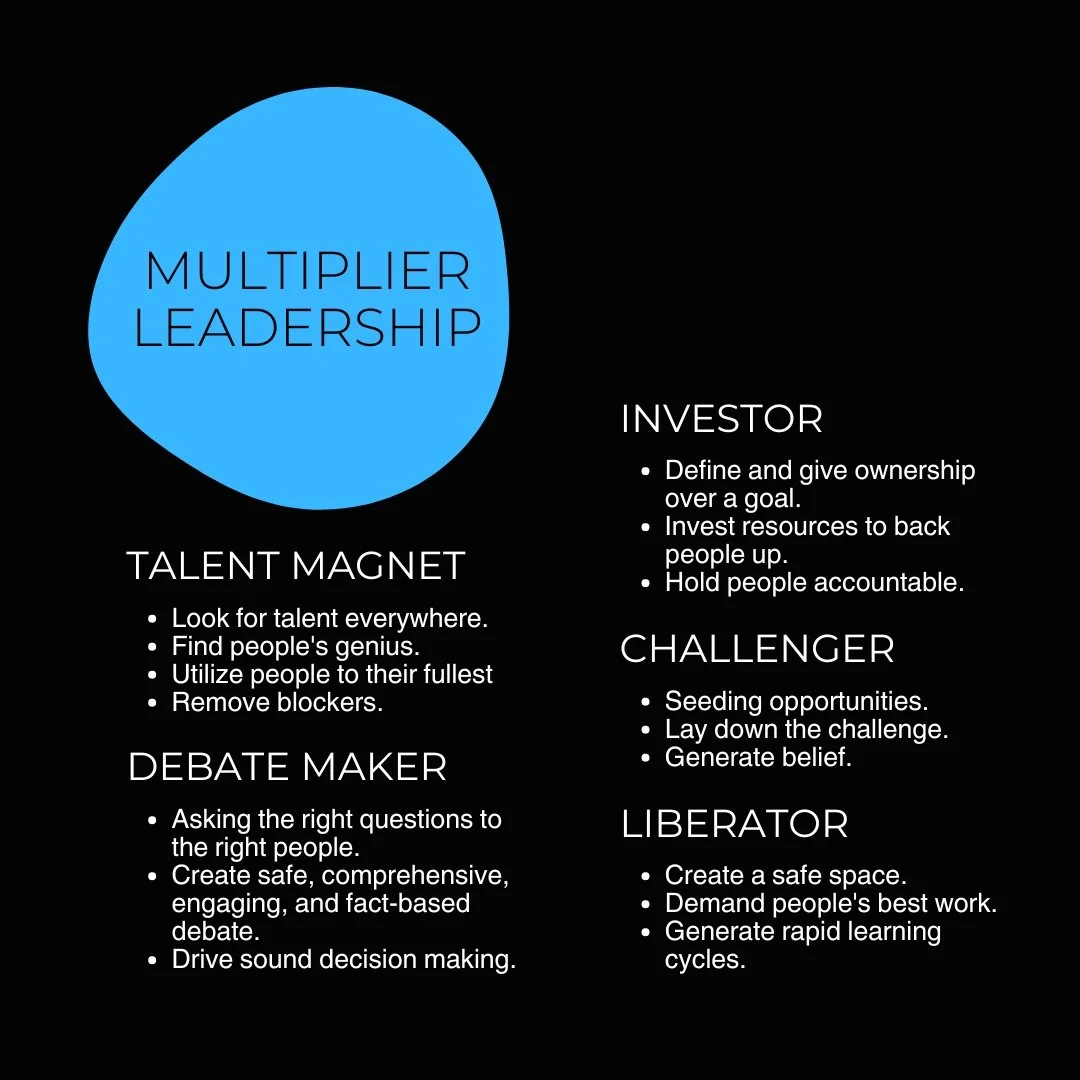
Liz Wiseman
Wiseman, L., & McKeown, G. (2010). Multipliers: How the Best Leaders Make Everyone Smarter. HarperCollins.

Description
The Multipliers Model, developed by Liz Wiseman and Greg McKeown (2010, revised 2017), identifies two opposing leadership archetypes based on how leaders use their intelligence and how they affect the intelligence of those around them.
Multipliers are leaders who amplify the smarts and capabilities of the people around them — they get more out of their teams. Diminishers are leaders who drain intelligence and energy from others, acting as if they are the smartest person in the room and creating dependent, under-utilised teams.
Based on research across more than 150 executives on four continents, Wiseman identified five disciplines that distinguish Multipliers from Diminishers:
- The Talent Magnet — Attracts and optimises talent (vs. the Empire Builder who acquires but underutilises talent)
- The Liberator — Creates space for people to do their best thinking (vs. the Tyrant who creates fear and tension)
- The Challenger — Stretches people beyond their known capabilities (vs. the Know-It-All who gives directions and stifles initiative)
- The Debate Maker — Drives sound decisions through rigorous debate (vs. the Decision Maker who decides unilaterally)
- The Investor — Instils accountability and invests in others' success (vs. the Micromanager who takes back ownership at the first sign of difficulty)
A key insight is the concept of the "Accidental Diminisher" — leaders who genuinely believe they are helping but are inadvertently diminishing others through behaviours like rescuing, always having the answer, or being too optimistic.
Wiseman's research found that on average, managers use only 66% of their people's capability. Multipliers extract and expand intelligence simultaneously, getting up to 2x more from their teams than Diminishers.
→ FranklinCovey Multipliers programme
Notes
- Closely related to Carol Dweck's Growth Mindset — Multipliers operate from an assumption that people are smart and capable of figuring things out.
- Complements Servant Leadership (Greenleaf) and Humble Leadership (Schein) in its emphasis on enabling others rather than self-promotion.
- The model has been applied extensively in tech (Apple, Google, Microsoft) and is used as a leadership development framework by FranklinCovey.
- Wiseman's follow-up work "Impact Players" (2021) extends the thinking to individual contributors within Multiplier organisations.
- See also: Multipliers Wikipedia entry
Other Sources
Books:
- Wiseman, L. (2010, revised 2017). Multipliers: How the Best Leaders Make Everyone Smarter. HarperCollins.
- Wiseman, L. (2021). Impact Players: How to Take the Lead, Play Bigger, and Multiply Your Impact. HarperCollins.
